Explains why jumping into design without a strategic foundation leads to expensive redesigns and inconsistent messaging. A simple strategy-first framework for founders and SMEs.
Most companies spend €30,000 on a redesign. Then realise they still can't explain what they do.
A new logo. New colours. New website. Beautiful work, produced by capable designers.
Still no clarity on the message. Still no consistency across channels. Still unable to explain why a client should choose them over a competitor.
The problem isn't the design. The problem is the order. Design came first.
Why Everyone Gets the Order Wrong
Design is tangible. Strategy isn't.
When a business decides it needs a new brand, the instinct is to call a designer. Show references. Pick a direction. Start seeing things that look like progress.
Strategy conversations feel slower. More abstract. You have to talk about who you're for, what you're not, what you believe, why someone would choose you over the alternatives. It's uncomfortable. It requires honesty. And it doesn't produce anything you can see.
So it gets skipped. Or abbreviated. Or collapsed into a single workshop afternoon before the "real" work begins.
The result is design that looks good and communicates nothing in particular. Because nothing in particular was decided before it was created.
What Strategy-First Actually Means
Brand strategy isn't a document you produce for its own sake. It's a set of decisions that make every downstream creative decision faster and better.
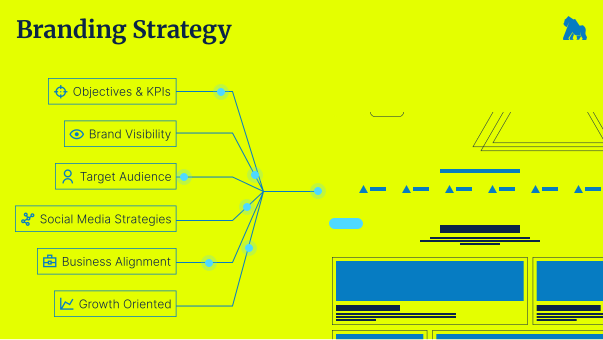
At a minimum, it addresses:
Positioning: What specific category does your brand occupy, and what's your distinct position within it? Not "we're a premium agency" — but precisely what kind of agency, for precisely what kind of client, doing precisely what kind of work.
Audience: Not demographics, but psychographics. What does your primary client believe, value, fear, and want? What does working with you allow them to achieve or become?
Differentiation: What do you offer that genuine alternatives don't — not just claim, but actually provide? This requires knowing what your competitors offer and being honest about where you genuinely diverge.
Voice and tone: How do you communicate? What's the register? What do you never say? This lives at the intersection of who you are and who you're talking to.
Brand truth: What do you believe about your category that others don't say out loud? This is the insight that makes your brand interesting rather than just competent.
These aren't branding exercises for their own sake. They're answers that your visual identity, your copy, your content, and your sales conversations all need in order to be coherent.
What Happens When You Skip It
The symptoms of strategy-skipped design are recognisable:
- Different team members describe the company differently to clients
- Marketing materials feel inconsistent even when the visual identity is consistent
- The website makes sense as a list of services but doesn't have a coherent point of view
- You can explain what you do but not clearly why you're different
- The brand looks good but doesn't feel distinctive
These aren't design problems. They're strategy problems wearing design's clothes.
A new round of design won't fix them. Only decisions will.
A Practical Framework
The strategy process doesn't need to be a six-month consulting engagement. Here's a simplified version that produces useful foundations:
1. Current state audit (1–2 hours)
Where does the business sit today? What's working, what isn't, what do clients say unprompted about working with you?
2. Audience definition (2–3 hours)
Who is the primary client? Not demographics — specific beliefs, goals, and problems. What does success look like for them?
3. Competitive landscape (2 hours)
What are the real alternatives? How do they position themselves? Where are the genuine gaps?
4. Positioning statement (half day)
A precise, honest articulation of what you do, for whom, and why it's different. This gets revised and sharpened — the first version is rarely the right one.
5. Voice and messaging principles (half day)
How does the brand communicate? Key phrases, patterns, things you never say.
Total: roughly two days of focused work. The outputs are decisions — not creative assets. Those come next.
When Strategy and Design Work Together
Done well, brand strategy doesn't constrain design. It liberates it.
A designer given clear strategic direction — this is who we are, this is who we're for, this is what we need to communicate — can make better creative decisions faster. They're not guessing what the brand should feel like. They know.
The brands that feel the most distinctive are usually the ones where strategy and design were most aligned from the start. The visual identity expresses something decided and believed, rather than something chosen because it looked good in the mood board.